SURAH 1

Surah Al-Fatiha

The Opening

Surah Al-Fatiha is the opening chapter of the Qur’an and contains seven verses. Its message centers on praise of God, mercy, worship, dependence and a prayer for guidance.

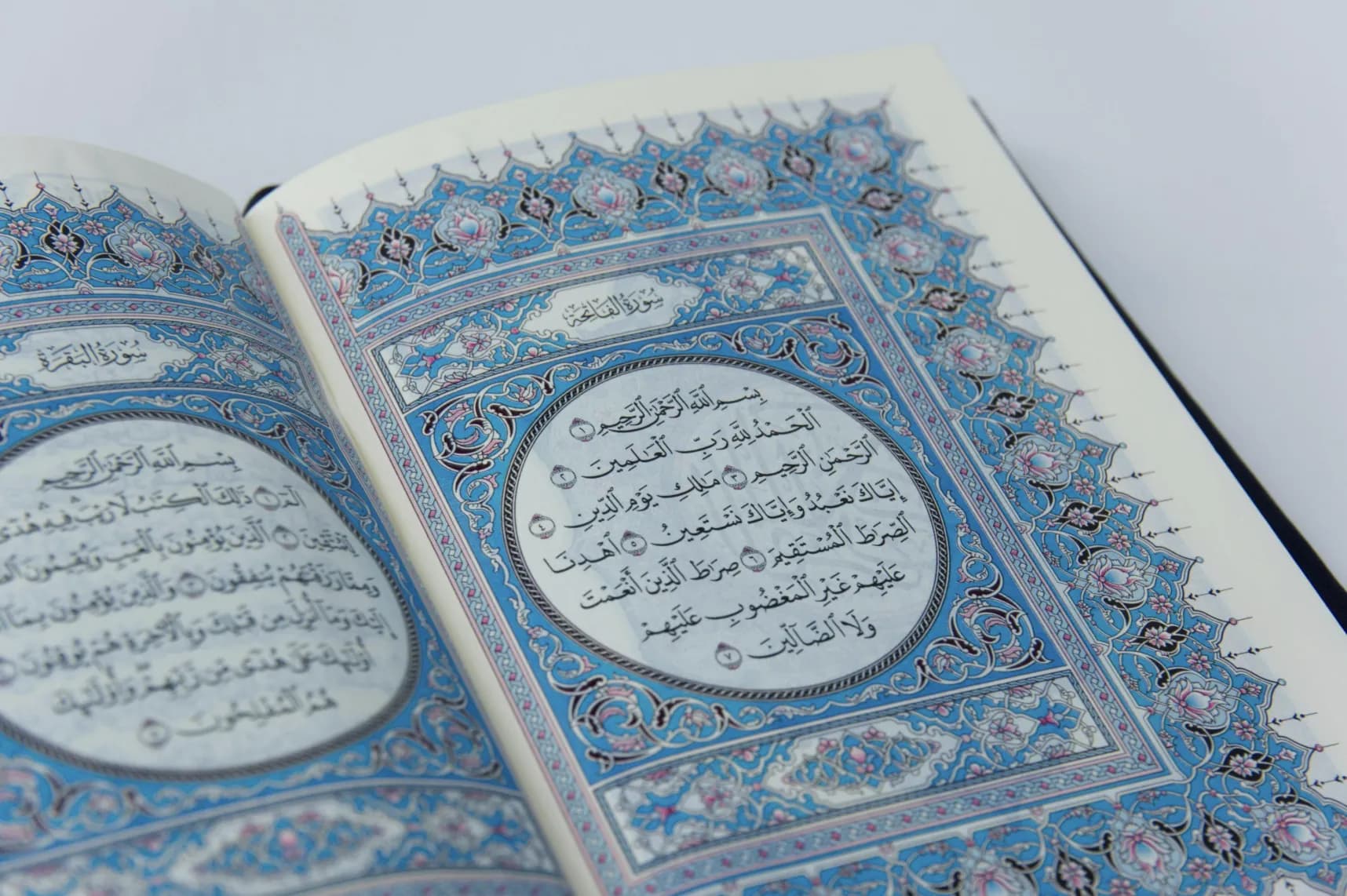
An open Qur’an in warm natural light
الفاتحة

The Opening

A DIRECT INTRODUCTION

What Is Surah Al-Fatiha?

Surah Al-Fatiha is the opening chapter of the Qur’an and contains seven verses. It is a prayer centered on praise of God, mercy, worship, dependence and guidance, and it has a central place in Muslim prayer.

QUR’AN TEXT

Read Surah Al-Fatiha

The Arabic text is the verified Tanzil Uthmani text. Choose an identified translation below; translation wording and source footnotes are displayed without rewriting.

The Qur’an is the Arabic text. Translations communicate meanings and remain clearly attributed to their source editions.

ENGLISH TRANSLATION

Translator: Saheeh International · Publisher: Noor International Center · Version 1.1.2

  1. بِسْمِ ٱللَّهِ ٱلرَّحْمَـٰنِ ٱلرَّحِيمِ

    English Translation

    In the name of Allāh,[2] the Entirely Merciful, the Especially Merciful.[3]

    Translation footnotes

    [2] Allāh is a proper name belonging only to the one Almighty God, Creator and Sustainer of the heavens and the earth and all that is within them, the Eternal and Absolute, to whom alone all worship is due. [3] Ar-Raḥmān and ar-Raḥeem are two names of Allāh derived from the word "raḥmah" (mercy) . In Arabic grammar both are intensive forms of "merciful" (i.e., extremely merciful) . A complimentary and comprehensive meaning is intended by using both together. Raḥmān is used only to describe Allāh, while raḥeem might be used to describe a person as well. The Prophet (ﷺ) was described in the Qur’ān as raḥeem. Raḥmān is above the human level (i.e., intensely merciful) . Since one usually understands intensity to be something of short duration, Allāh describes Himself also as raḥeem (i.e., continually merciful) . Raḥmān also carries a wider meaning - merciful to all creation. Justice is a part of this mercy. Raḥeem includes the concept of speciality - especially and specifically merciful to the believers. Forgiveness is a part of this mercy. In addition, Raḥmān is adjectival, referring to an attribute of Allāh and is part of His essence. Raḥeem is verbal, indicating what He does: i.e., bestowing and implementing mercy.

  2. ٱلْحَمْدُ لِلَّهِ رَبِّ ٱلْعَـٰلَمِينَ

    English Translation

    [All] praise is [due] to Allāh, Lord[4] of the worlds -

    Translation footnotes

    [4] When referring to Allāh (subḥānahu wa taʿālā) , the Arabic term "rabb" (translated as "Lord") includes all of the following meanings: "owner, master, ruler, controller, sustainer, provider, guardian and caretaker."

  3. ٱلرَّحْمَـٰنِ ٱلرَّحِيمِ

    English Translation

    The Entirely Merciful, the Especially Merciful,

  4. مَـٰلِكِ يَوْمِ ٱلدِّينِ

    English Translation

    Sovereign of the Day of Recompense.[5]

    Translation footnotes

    [5] i.e., repayment and compensation for whatever was earned of good or evil during life on this earth.

  5. إِيَّاكَ نَعْبُدُ وَإِيَّاكَ نَسْتَعِينُ

    English Translation

    It is You we worship and You we ask for help.

  6. ٱهْدِنَا ٱلصِّرَٰطَ ٱلْمُسْتَقِيمَ

    English Translation

    Guide us to the straight path -

  7. صِرَٰطَ ٱلَّذِينَ أَنْعَمْتَ عَلَيْهِمْ غَيْرِ ٱلْمَغْضُوبِ عَلَيْهِمْ وَلَا ٱلضَّآلِّينَ

    English Translation

    The path of those upon whom You have bestowed favor, not of those who have earned [Your] anger or of those who are astray.

Arabic Qur’an text: Tanzil Project, Uthmani version 1.1. English translation: English Translation - Noor International Center, version 1.1.2, published by Noor International Center.

EDITORIAL EXPLANATION

Key Themes of Surah Al-Fatiha

These concise descriptions are The Way Islam editorial explanations. They are not Qur’an translation text.

  1. 01

    Praise

    Recognition and praise of God.

  2. 02

    Mercy

    God’s mercy is emphasized at the beginning of the Surah.

  3. 03

    Worship and Dependence

    The Surah expresses worship of God and reliance upon Him.

  4. 04

    Guidance

    The prayer asks for guidance to the straight path.

  5. 05

    Accountability

    The Surah connects faith with awareness of judgment and human responsibility.

EDITORIAL OVERVIEW

About Surah Al-Fatiha

Surah Al-Fatiha opens the Qur’an. Its seven verses form a complete prayer whose movement begins with praise and mercy, turns to worship and dependence, and concludes with a request for guidance.

This overview explains the structure of the Surah without presenting editorial wording as scripture or translation.

CONCEPTUAL MOVEMENT

The Structure of Surah Al-Fatiha

  1. 01

    Praise and Mercy

    Opening recognition of God and His mercy.

  2. 02

    Accountability

    Recognition of the Day of Judgment.

  3. 03

    Worship and Dependence

    A declaration of worship and reliance on God.

  4. 04

    Guidance

    A direct prayer for guidance.

  5. 05

    The Straight Path

    A request to remain on the path of those who receive divine favor.

EDITORIAL EXPLANATION

Understanding the Verses

These concise notes describe the movement and themes of the Surah. They are The Way Islam editorial explanations, not Qur’an translation or Tafsir.

  1. QUR’AN 1:1

    Beginning With God’s Name

    The opening invokes God by name and places mercy at the beginning of the Surah. This editorial note identifies the theme without replacing a translation of the Arabic text.

    Qur’an 1:1
  2. QUR’AN 1:2

    Praise and Lordship

    The prayer moves into praise and recognizes God as Lord and sustainer of all worlds. Praise is presented as the starting posture of the worshipper.

    Qur’an 1:2
  3. QUR’AN 1:3

    Mercy Repeated

    Mercy is emphasized again immediately after praise. Its repetition gives mercy a defining place in the opening movement of the Surah.

    Qur’an 1:3
  4. QUR’AN 1:4

    Accountability

    The Surah joins mercy with awareness of judgment. Human life is therefore approached with both hope and moral responsibility.

    Qur’an 1:4
  5. QUR’AN 1:5

    Worship and Dependence

    The central declaration brings worship and the request for help together. Devotion to God is paired with dependence upon Him.

    Qur’an 1:5
  6. QUR’AN 1:6

    A Prayer for Guidance

    After praise, mercy, accountability and worship, the speaker asks for guidance. Guidance is presented as an ongoing need rather than a possession taken for granted.

    Qur’an 1:6
  7. QUR’AN 1:7

    The Path Described

    The final Ayah develops the request for guidance by distinguishing the desired path from ways associated with error and loss. Detailed interpretation requires clearly identified commentary sources.

    Qur’an 1:7

WORSHIP AND LEARNING

Surah Al-Fatiha in Muslim Prayer

Surah Al-Fatiha has a central place in formal Muslim prayer. Reports recorded in Sahih al Bukhari and Sahih Muslim connect recitation of the opening chapter with prayer.

Legal details concerning recitation by an imam, a person praying behind an imam and a person praying alone include distinctions discussed by Islamic jurists. This introductory page therefore states the central role of Surah Al-Fatiha without presenting one detailed legal treatment as the only view.

SOURCE TRANSPARENCY

Sources and References

Qur’an text, the currently displayed translation, Hadith references and editorial explanation remain visibly distinct.

QUR’AN TEXT

Tanzil Uthmani Qur’an Text

Version 1.1. Stored locally as protected data and validated against source metadata and SHA-256 checksums.

Tanzil Quran Text, Copyright © 2007 to 2021 Tanzil Project. Licensed under Creative Commons Attribution 3.0. Verbatim copying is permitted and changing the Qur’an text is not allowed.

  1. hadith

    Sahih al Bukhari 756

    Book of the Call to Prayer, Book 10, Hadith 150

    View reference
  2. hadith

    Sahih Muslim 394a

    The Book of Prayers, Book 4, Hadith 37

    View reference
  3. methodology

    The Way Islam Sources and Methodology

    Source hierarchy, translation rights and editorial explanation policy

    View reference
ENGLISH TRANSLATION

English Translation - Noor International Center

Saheeh International. Published by Noor International Center. QuranEnc key english_saheeh, version 1.1.2. Translation and footnotes are reproduced verbatim.